
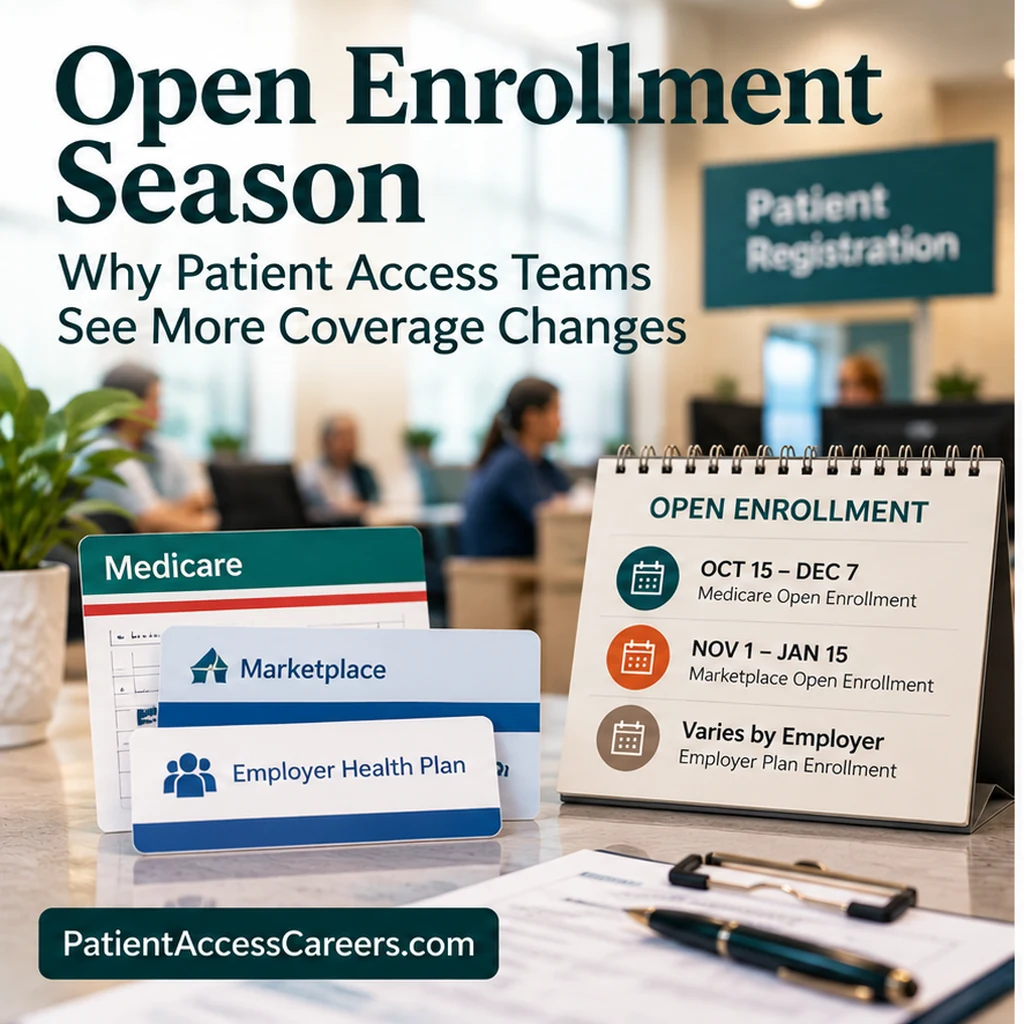
Open Enrollment season creates a predictable wave of insurance changes at the front end. Patients may arrive with a new plan, a plan that has not started yet, a different member number, or a card that looks current even though another plan will take effect later.
Open Enrollment does not follow one calendar
There is no single Open Enrollment period for every type of health coverage. Medicare’s annual Open Enrollment Period runs from October 15 through December 7. The federal Health Insurance Marketplace generally uses November 1 through January 15, while employer-sponsored plans may use different enrollment windows.
That means Patient Access may see several kinds of coverage changes at the same time, each with different effective dates. The registration question is not which plan the patient prefers. It is which coverage applies to the service being performed on a specific date.
A new card may not be active yet
A patient registering in November or December may already have received a card for coverage beginning January 1. Their existing plan may still apply to today’s encounter. The reverse can happen too: a patient may present an older card even though a new plan has already become effective.
Do not replace coverage simply because one card looks newer. Verify effective dates through the organization’s approved eligibility process and match the result to the date of service.
The carrier can stay the same while the plan changes
A patient may say that their insurance is the same and be completely sincere. The carrier name may be unchanged while the underlying product, network, member identification number, deductible, copayment, coinsurance, or other benefit details have changed.
That is why copying last year’s insurance record forward without verification creates risk. Confirm the member information and the plan that applies to the encounter rather than relying on the familiar logo on the card.
Future services need future-date verification
Coverage verification should match the date on which the service is expected to occur. A procedure scheduled in December may use one plan while a follow-up visit in January uses another.
Authorization adds another layer. An approval obtained under one plan should not automatically be assumed to remain valid after coverage changes. If the payer, product, provider network, service location, or other relevant information changes, follow the organization’s process for determining whether new authorization work is required.
Ask about changes without interrogating the patient
Open Enrollment season does not require turning every registration into a long insurance interview. Neutral questions such as “Has your insurance changed since your last visit?” and “Do you have any new coverage that begins before this service?” can uncover the information needed to verify the account.
For future appointments, staff may need to explain why coverage will be verified again closer to the service date. The goal is accurate information, not asking the patient to interpret insurance rules for the organization.
Build a workflow for year-end changes
Patient Access leaders should expect more insurance maintenance work in late December and January. Work queues can identify scheduled accounts that cross into a new plan year, and teams should have clear escalation paths for inactive responses, changed member numbers, network questions, coordination-of-benefits issues, and authorization concerns.
Good documentation also prevents the patient from explaining the same coverage change repeatedly to scheduling, registration, authorization, and financial counseling. Open Enrollment creates more change, but the core principle stays the same: verify what applies to this patient, for this service, on this date.
Frequently asked questions
Does a new insurance card automatically replace the plan already on the account?
No. Verify the new plan’s effective date and determine which coverage applies to the date of service before replacing or inactivating existing information.
If eligibility shows active coverage is the service guaranteed to be paid?
No. Eligibility alone does not guarantee network participation, authorization, covered benefits, medical necessity, coding, or final payment.
Should Patient Access help patients choose between insurance plans?
Patient Access should explain the organization’s registration and financial processes rather than recommend a particular health plan. Follow organizational policy and refer patients to appropriate enrollment resources when needed.
Build your Patient Access career
Want the career roadmap behind the work? Explore Breaking Into Patient Access for guidance on entering the field, evaluating openings, preparing for interviews, and building a long-term path. This knowledge-base article focuses on the industry topic and does not reproduce the guide’s career-planning material.
Related Knowledge Base articles
- Medicare Secondary Payer Screening Is More Than an Insurance Card Check
- Prior Authorization Is Changing What Patient Access Teams Need to Know
- Preventing Front End Claim Denials Without Turning Registration Into an Interrogation
Sources and further reading
- CMS Medicare Open Enrollment Partner Resources
- Medicare.gov Joining a Health or Drug Plan
- HealthCare.gov Open Enrollment Dates and Deadlines
Information checked October 27 2026. Follow current government guidance, payer requirements, state law, and your employer’s approved workflow.




Leave a Reply